
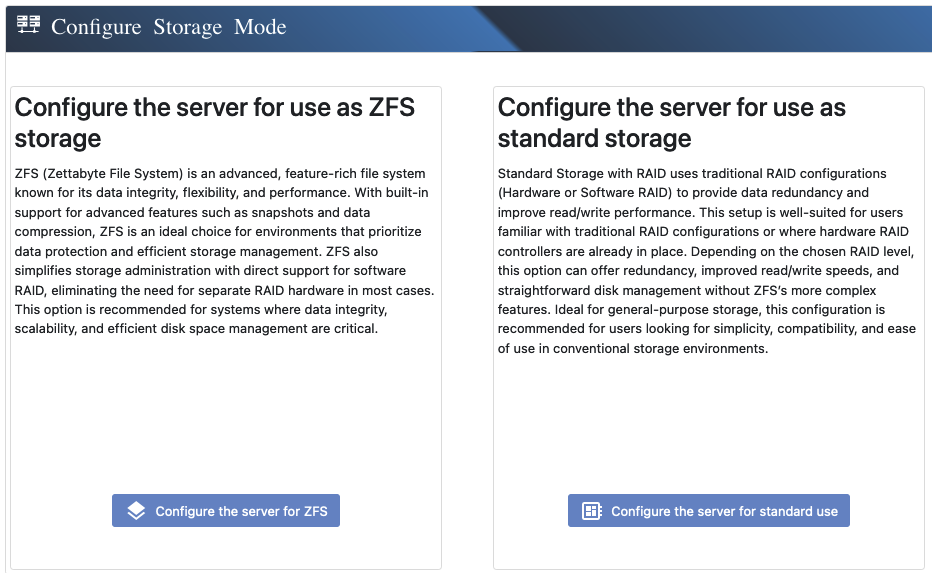
euroNAS Premium offers two powerful storage modes to suit different performance and reliability needs: ZFS Mode and Standard Mode. This flexibility allows you to tailor your storage environment precisely to your infrastructure, use case, and resource profile.
ZFS Mode – Advanced Data Protection and Enterprise Features
ZFS Mode is ideal for environments where data integrity, redundancy, and advanced features are critical. It includes a rich set of enterprise-class capabilities built directly into the file system.
Advantages of ZFS Mode:
- End-to-End Checksumming – Detects and corrects silent data corruption
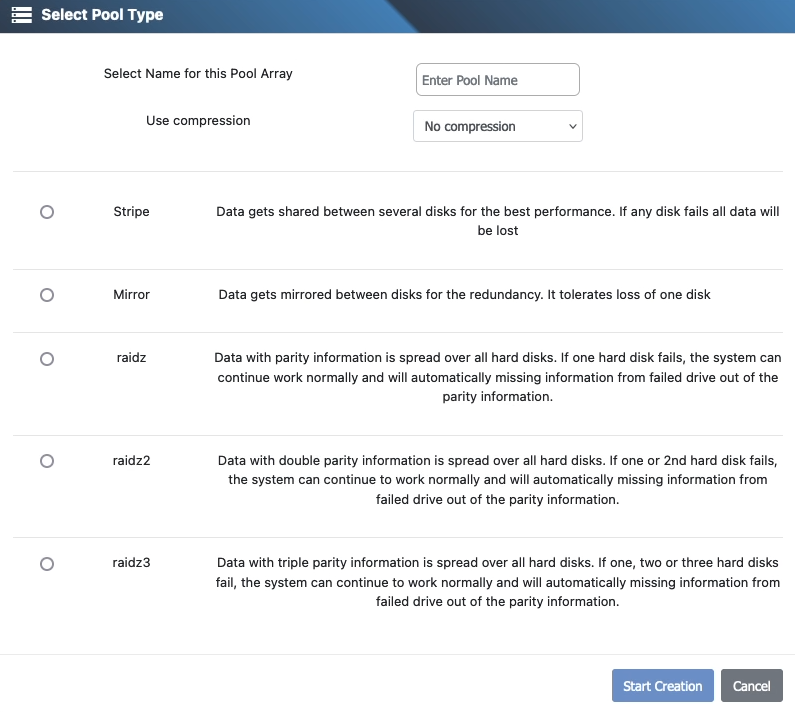
- Integrated Software RAID – Use RAID-Z, mirrors, or stripes without external controllers
- Snapshot – Create space-efficient snapshots
- Inline Compression – Saves space and boosts performance for compressible data
- Self-Healing File System – Automatically repairs corrupted data when redundancy is available
- Advanced Caching – ARC and L2ARC support for read/write performance enhancement
ZFS Mode is best suited for mission-critical storage, backup servers, and VM storage requiring maximum data reliability and advanced storage features.
Standard Mode (XFS) – Simplicity and High Performance
Standard Mode uses the XFS file system, known for its speed, efficiency, and scalability. It’s a better fit for environments using hardware RAID controllers or where low overhead and fast I/O are a priority.
Advantages of Standard Mode:
- High Throughput – Excellent performance with large files and high IOPS workloads
- Lightweight Operation – Lower CPU and RAM usage compared to ZFS
- Simple Setup – Ideal for straightforward NAS deployments
- Optimised for External RAID – Works seamlessly with hardware RAID setups
- Stable and Mature – Proven reliability in production environments
Standard Mode is recommended for general-purpose Storage systems, media streaming, or when running on systems with limited resources.