
S3 Browser - End User Portal and Branding
The eEKAS S3 Browser is the end-user portal for S3 access. It is separate from the administrator-focused S3 Service Console.
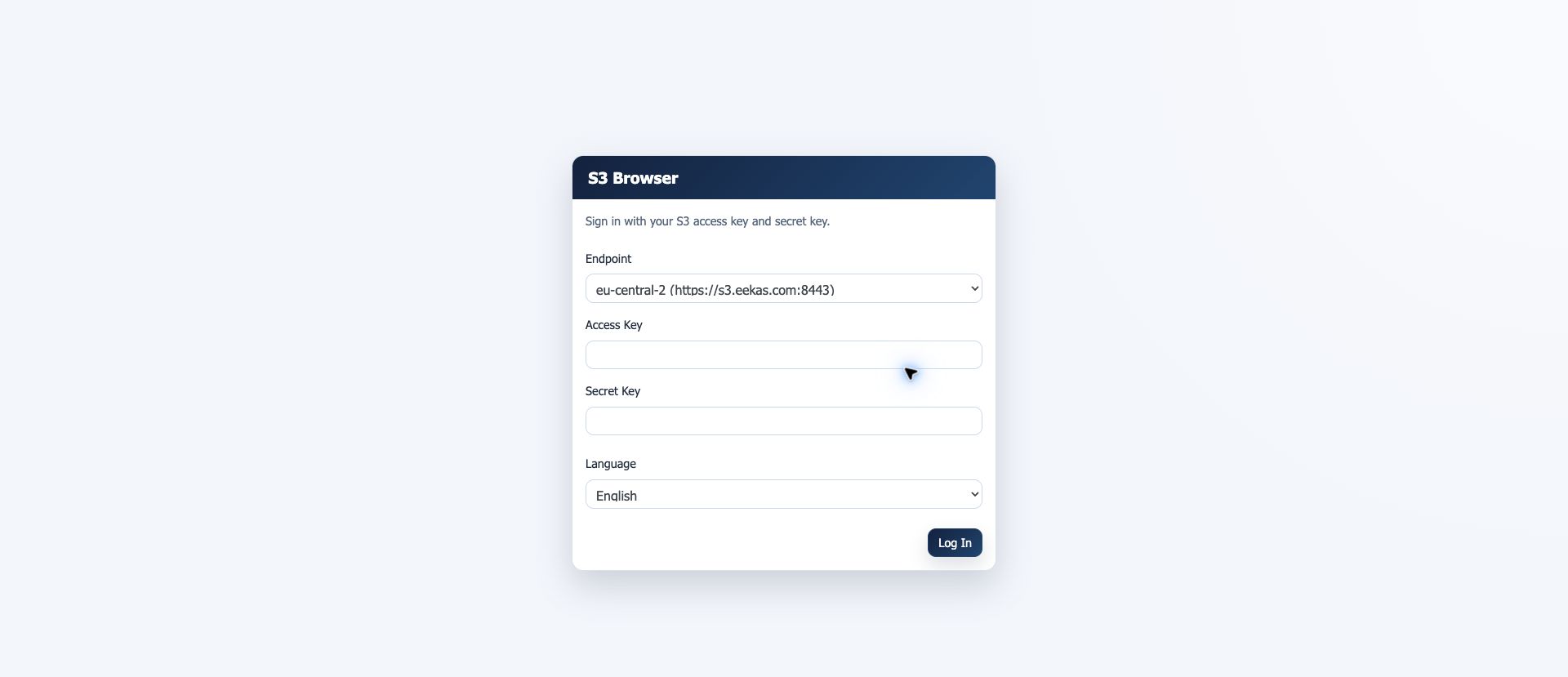
Login
Users log in with:
- Endpoint selection.
- Access key.
- Secret key.
- Language selection.
The captured system exposes the endpoint eu-central-2 (https://s3.eekas.com:8443) and supports English, German and Polish in the login UI.
In the live test, the normal user backup-service created from the S3 Users tab could log in successfully. The page displayed the signed-in user, masked access key, bucket limit and quota state.
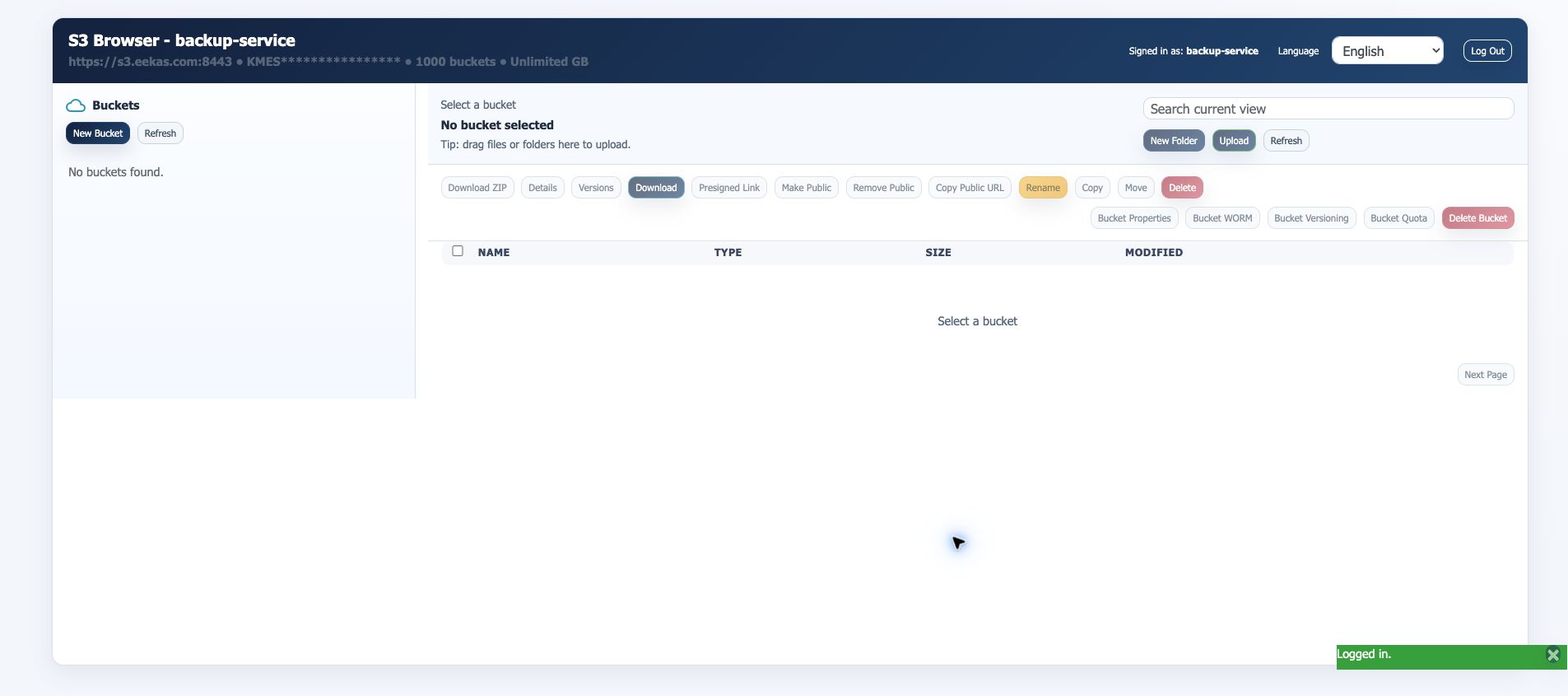
Endpoint Prerequisites
The S3 Browser login depends on the selected endpoint and the S3 Browser backend being able to reach the correct S3 service.
During testing, a direct client request to https://s3.eekas.com:8443 returned an HTTP redirect to login.php instead of behaving like a direct S3 gateway endpoint. The S3 Browser web application still authenticated a normal Users-tab user successfully. This means the browser workflow can work even when direct S3 client tests need separate endpoint validation.
Before documenting end-user login as complete, verify:
- DNS for the S3 endpoint points to the correct eEKAS S3 service address.
- The published port is the S3 gateway port, not an unrelated web administration service.
- TLS certificate and hostname match the endpoint users select.
- The S3 Browser can authenticate the user.
- A separate S3 client test is performed against the intended S3 API endpoint.
- Direct S3 client tests do not redirect to a non-S3 login page.
Bucket Creation From the S3 Browser
The S3 Browser allows a signed-in user to create buckets when the user has sufficient permission and bucket quota.
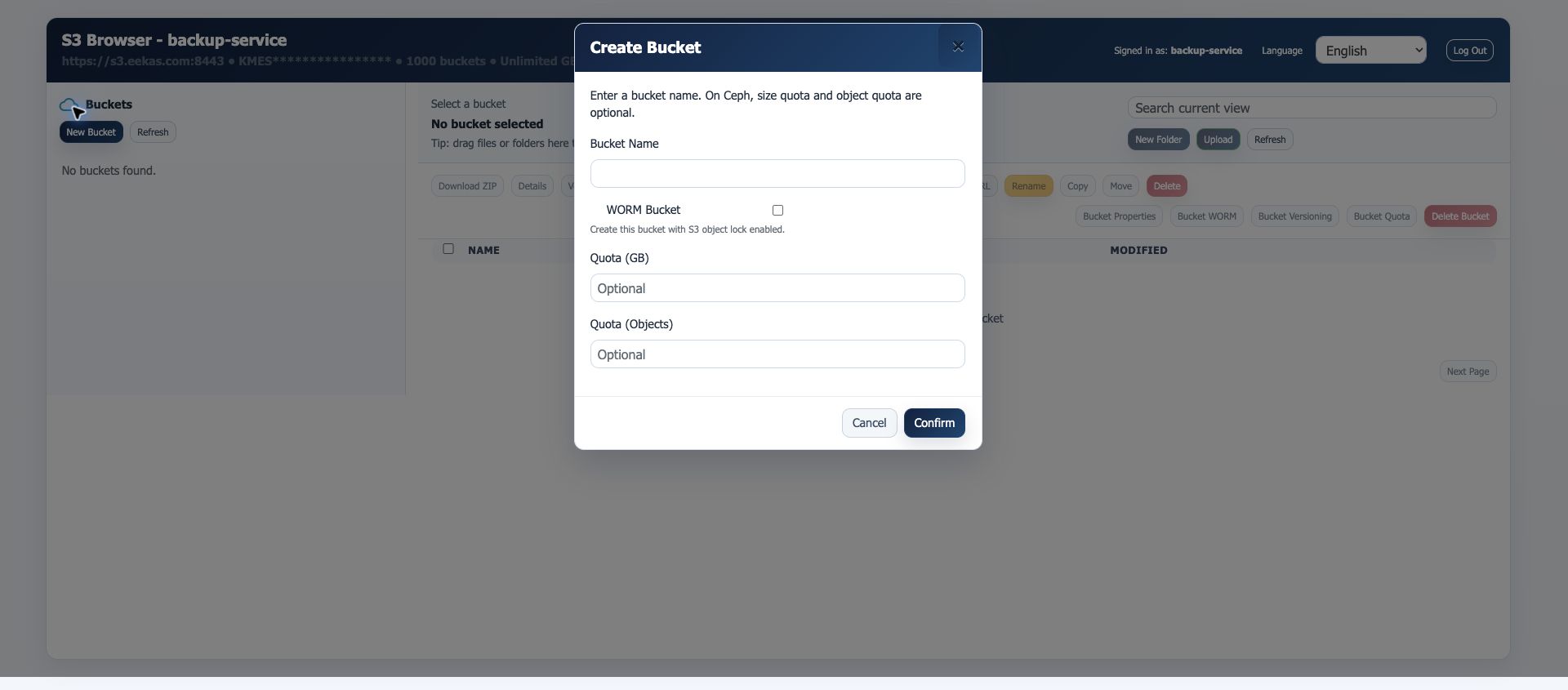
Available options in the bucket creation dialog:
| Option | Description |
|---|---|
| Bucket Name | Name of the new S3 bucket. |
| WORM Bucket | Creates the bucket with S3 Object Lock enabled. Decide this before production creation because protected buckets are harder to remove later. |
| WORM Mode | Governance or compliance mode when WORM is enabled. |
| WORM Days / Years | Default object retention period when WORM is enabled. |
| Quota GB | Optional storage quota for the bucket. |
| Quota Objects | Optional object-count quota for the bucket. |
Test result: the normal user backup-service created the bucket backup-reports-2026 successfully. The bucket was removed again after the documentation test.
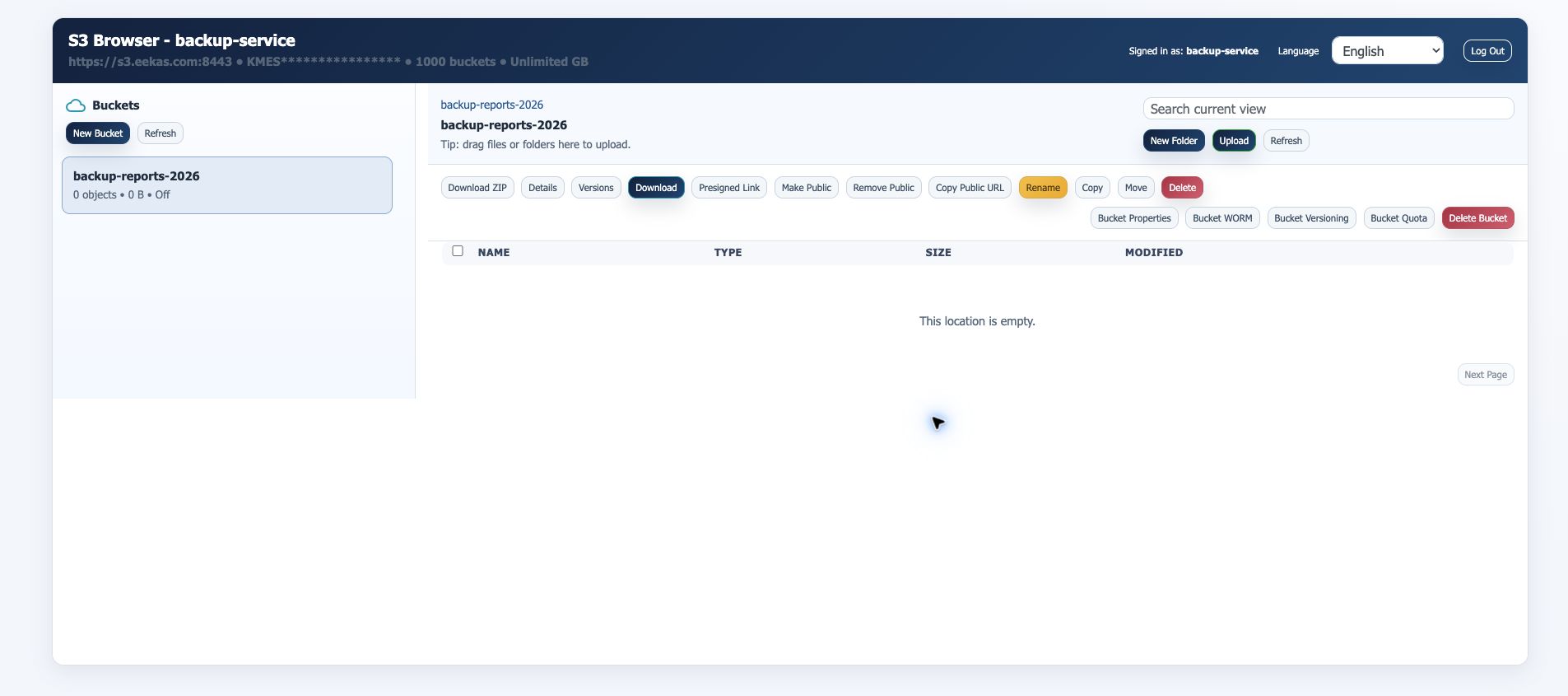
End-User Functions
The live S3 Browser UI exposes the following functions:
- New Bucket.
- Refresh buckets.
- Search current view.
- New Folder.
- Upload.
- Refresh objects.
- Download ZIP.
- Details.
- Versions.
- Download.
- Presigned Link.
- Make Public.
- Remove Public.
- Copy Public URL.
- Rename.
- Copy.
- Move.
- Delete.
- Bucket Properties.
- Bucket WORM.
- Bucket Versioning.
- Bucket Quota.
- Delete Bucket.
These functions allow non-administrator users to work with object storage through a browser-style interface instead of command-line tools.
Upload Workflow
The S3 Browser upload workflow was verified with a normal Users-tab user after Chrome file access was enabled for the browser extension.
Test flow:
- Create the bucket
backup-reports-2026. - Click
Upload. - Select the local file
eekas-s3-doc-test.txt. - Confirm that the object appears in the bucket object list.
- Refresh the bucket list and verify that the bucket count changes to
1 objects.
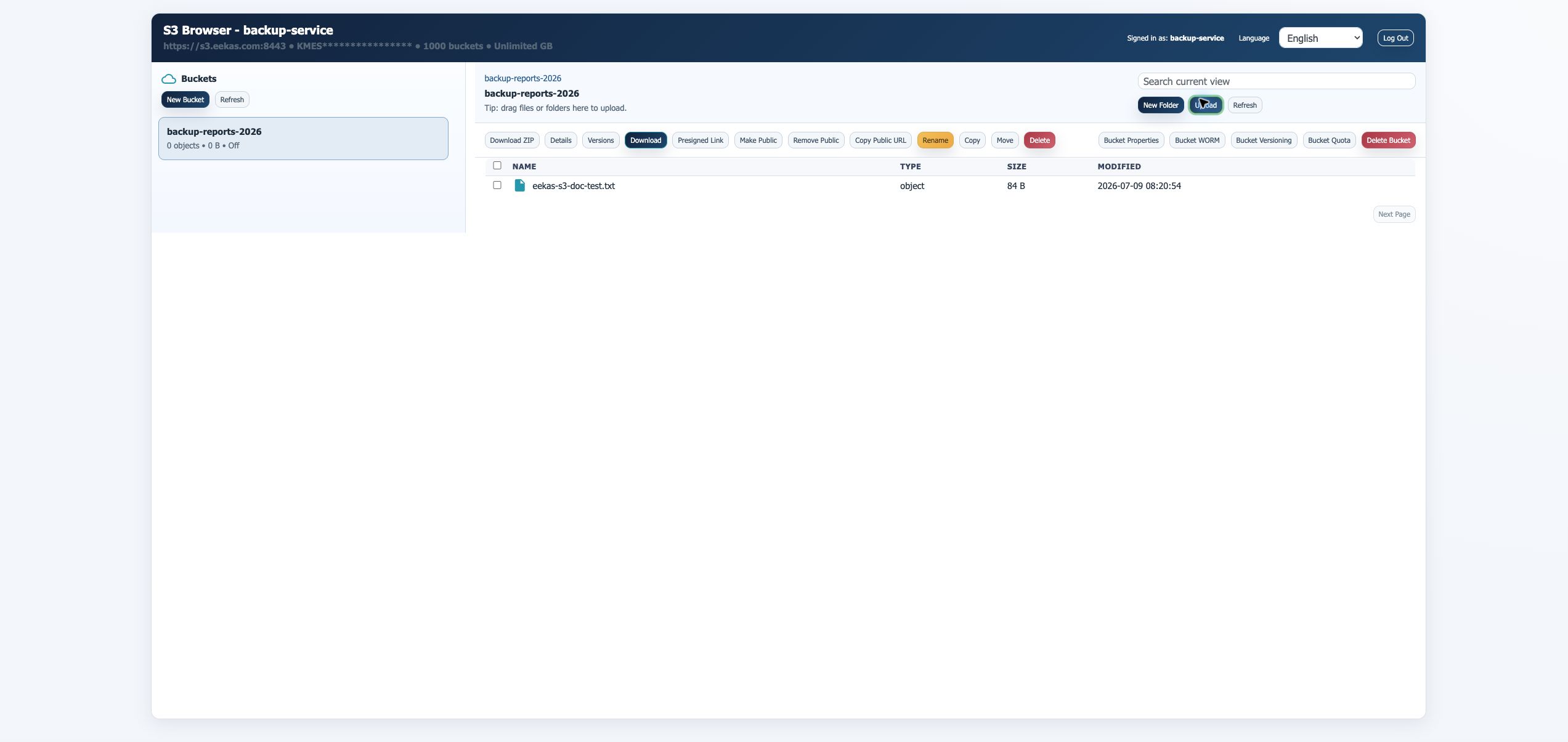
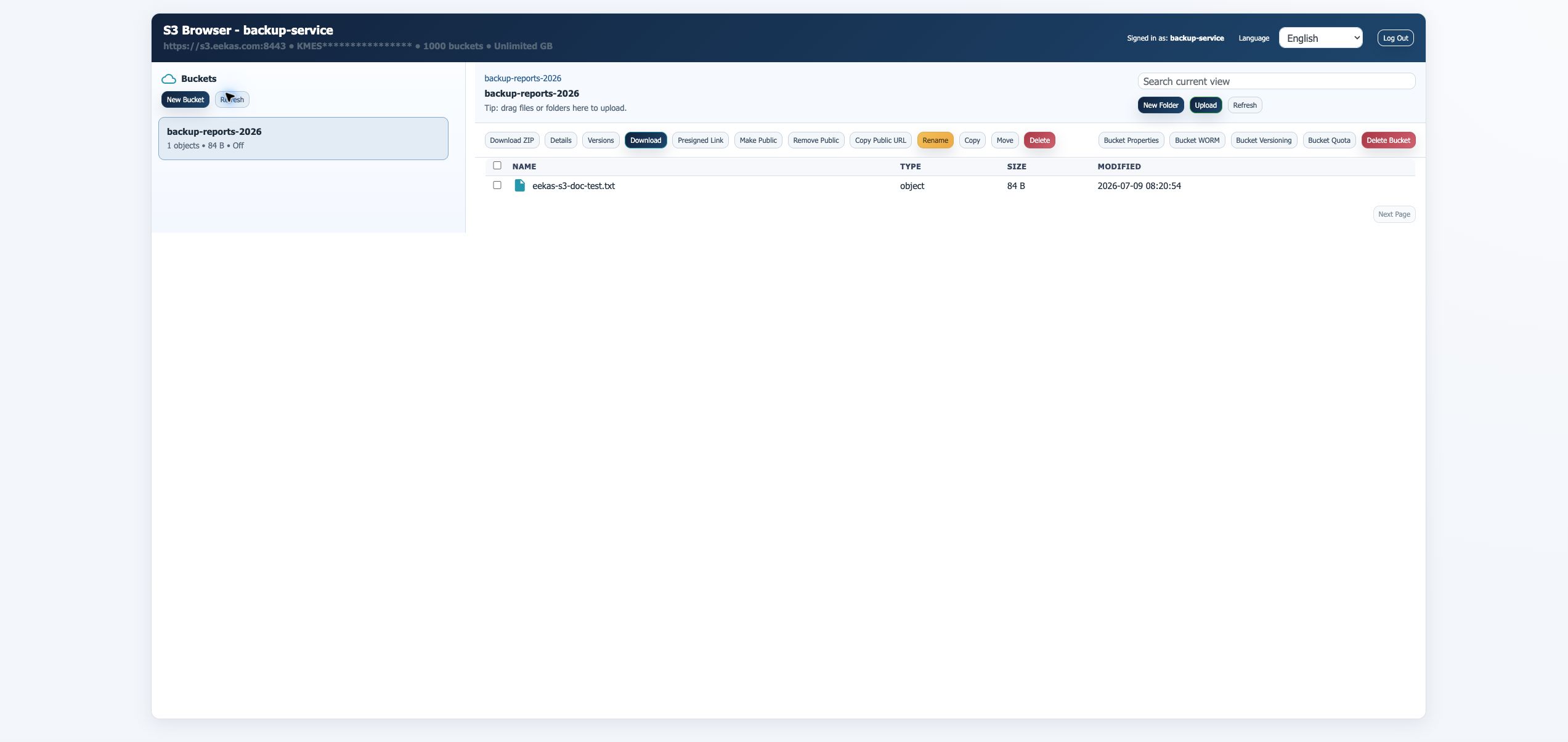
The temporary uploaded object and bucket were removed after the test.
Object and Bucket Workflows
The following object and bucket workflows were captured successfully:
- Object list with
backup-test-note.txt. - Object Details.
- Version History.
- Presigned Link dialog.
- Make Public confirmation dialog.
- Bucket Properties.
- Bucket Versioning.
- Bucket Quota.
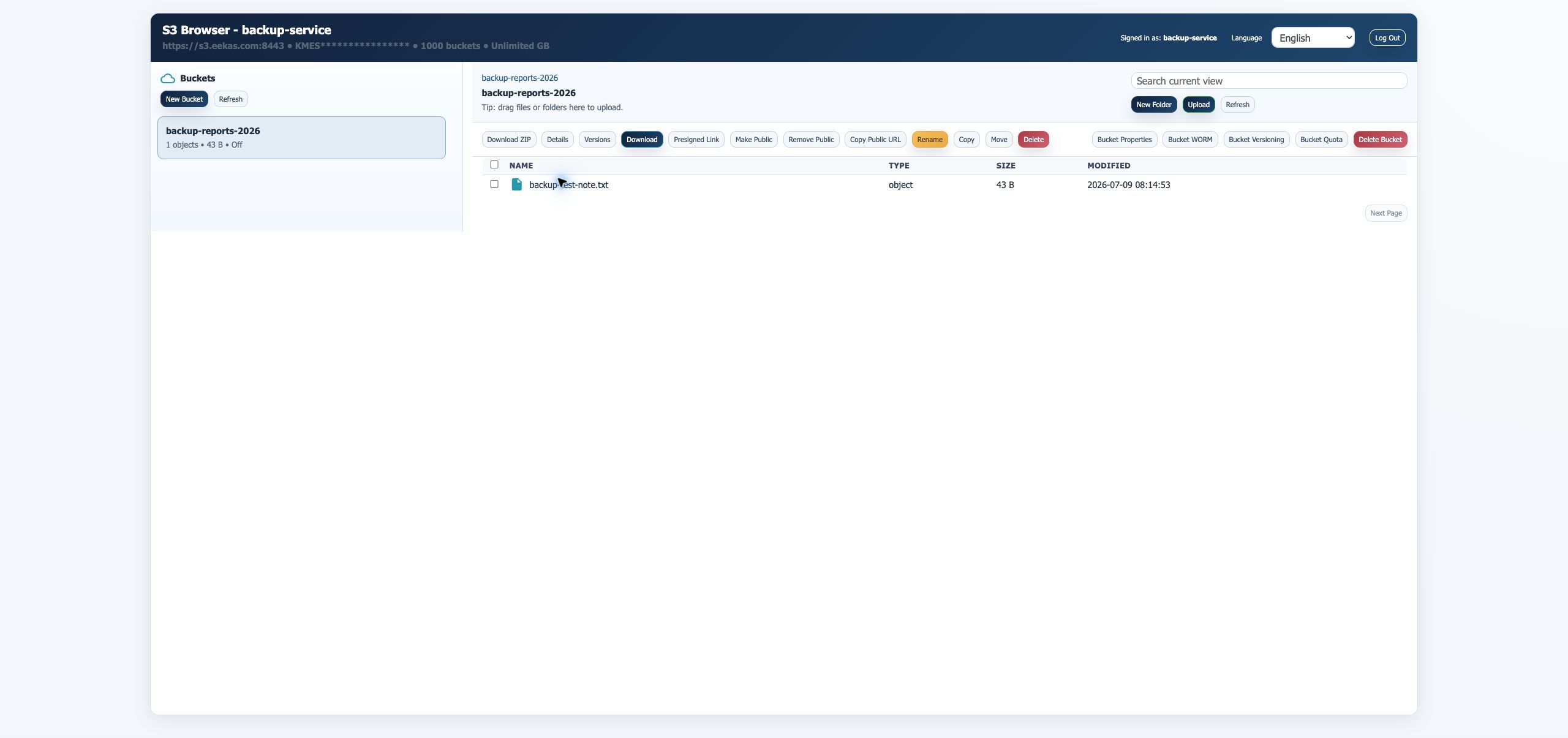
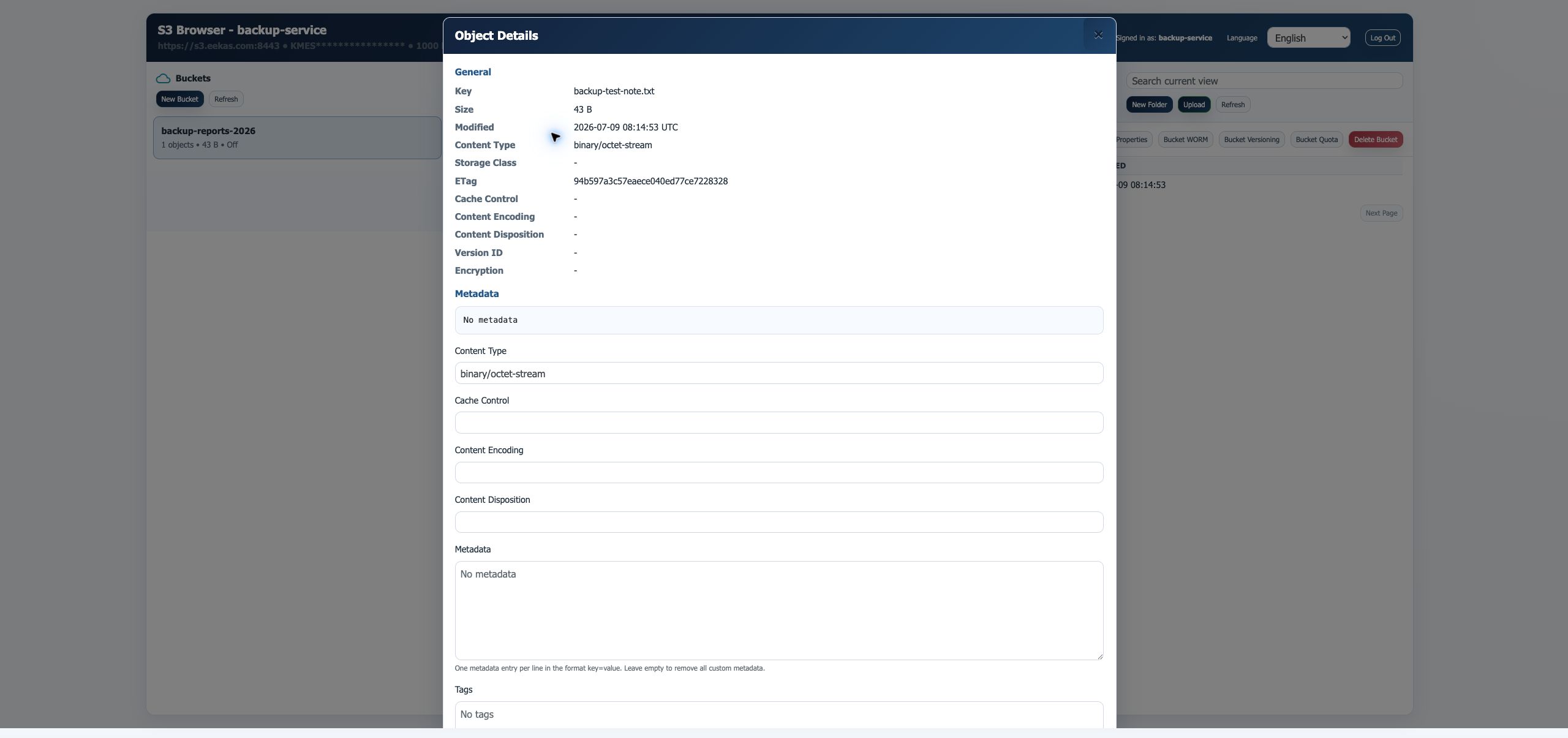
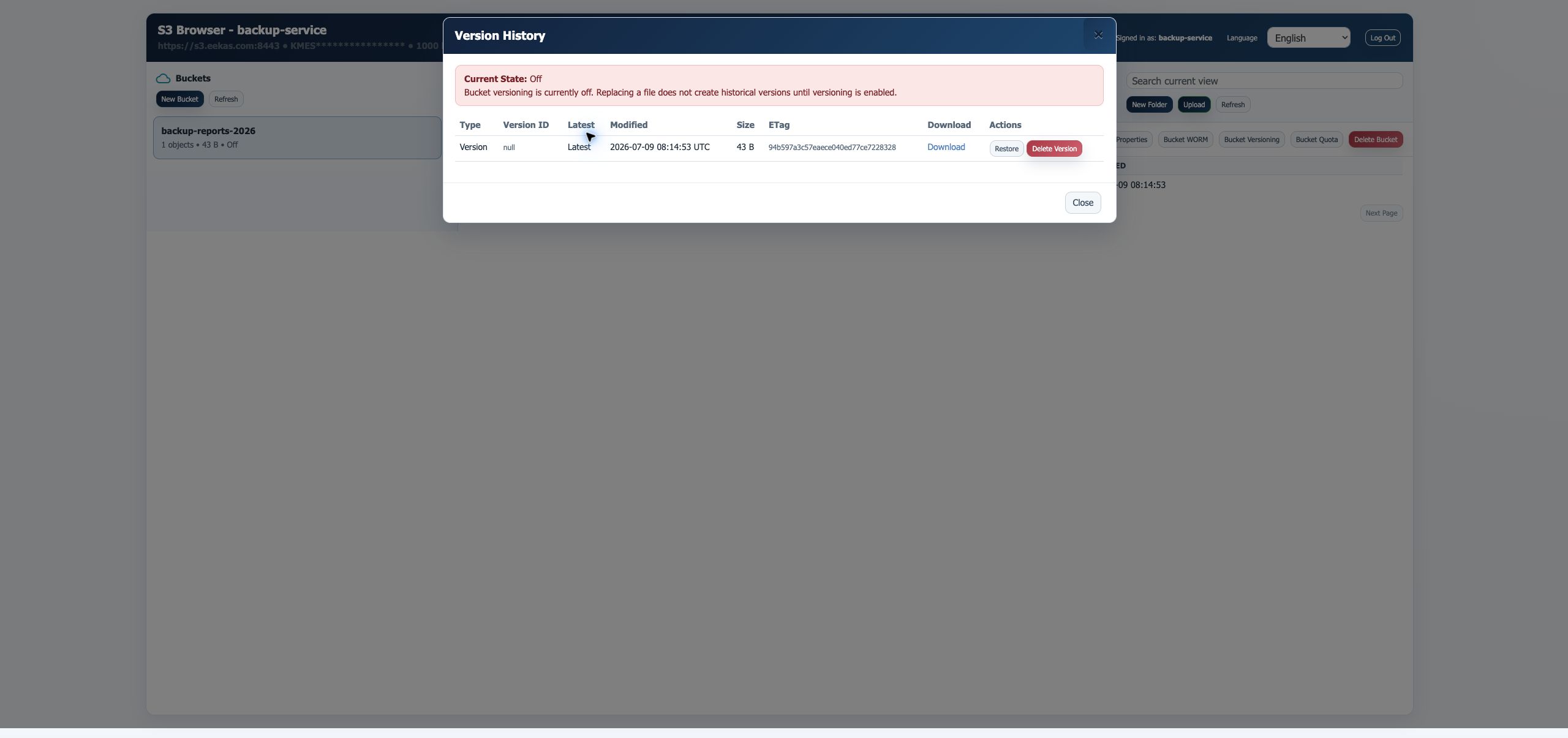
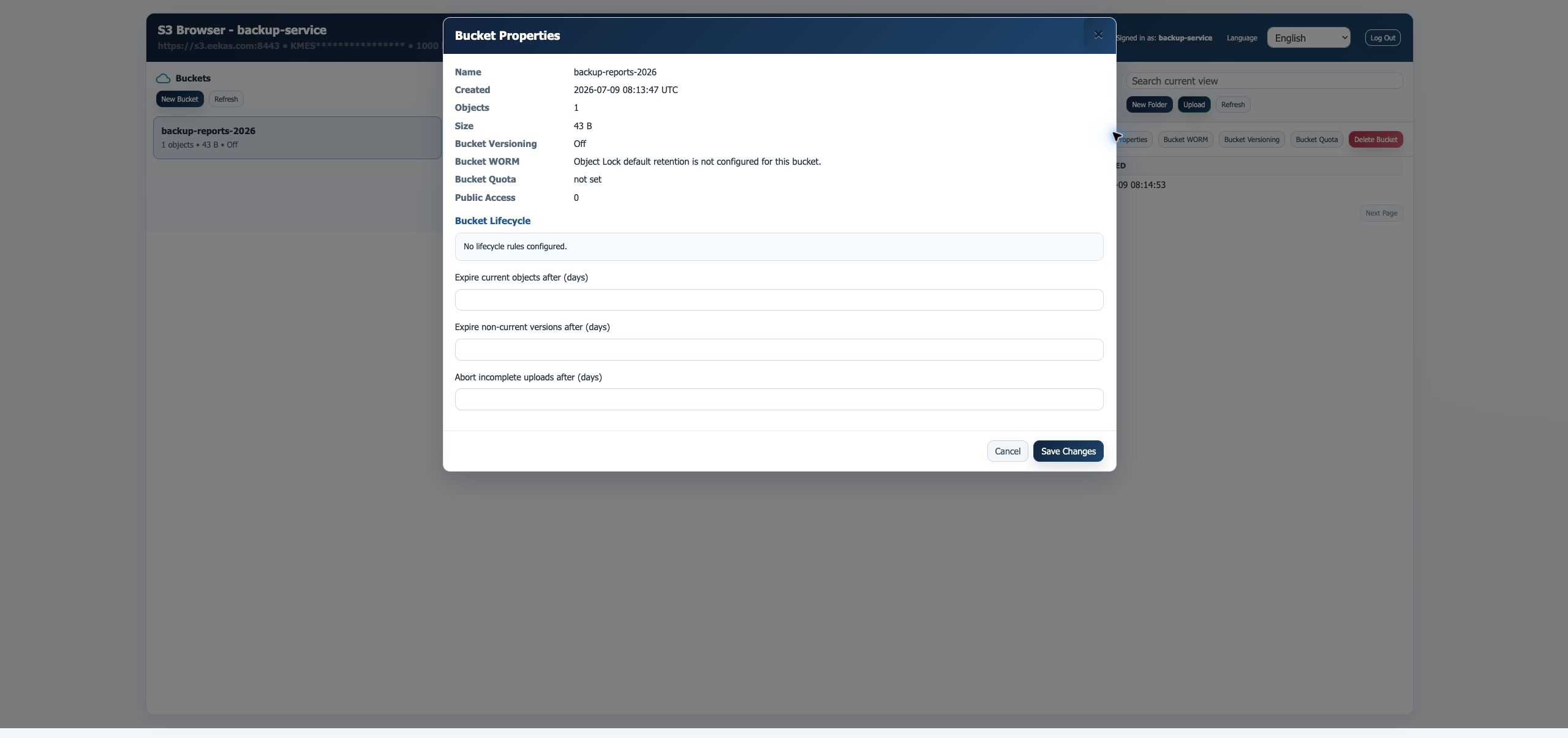
The object workflow screenshots use backup-test-note.txt; the verified UI upload screenshots use eekas-s3-doc-test.txt. Both were temporary test objects and were removed after capture.
Branding and Browser Settings
Administrators can customize the S3 Browser from S3 Management using Customize S3 Browser.
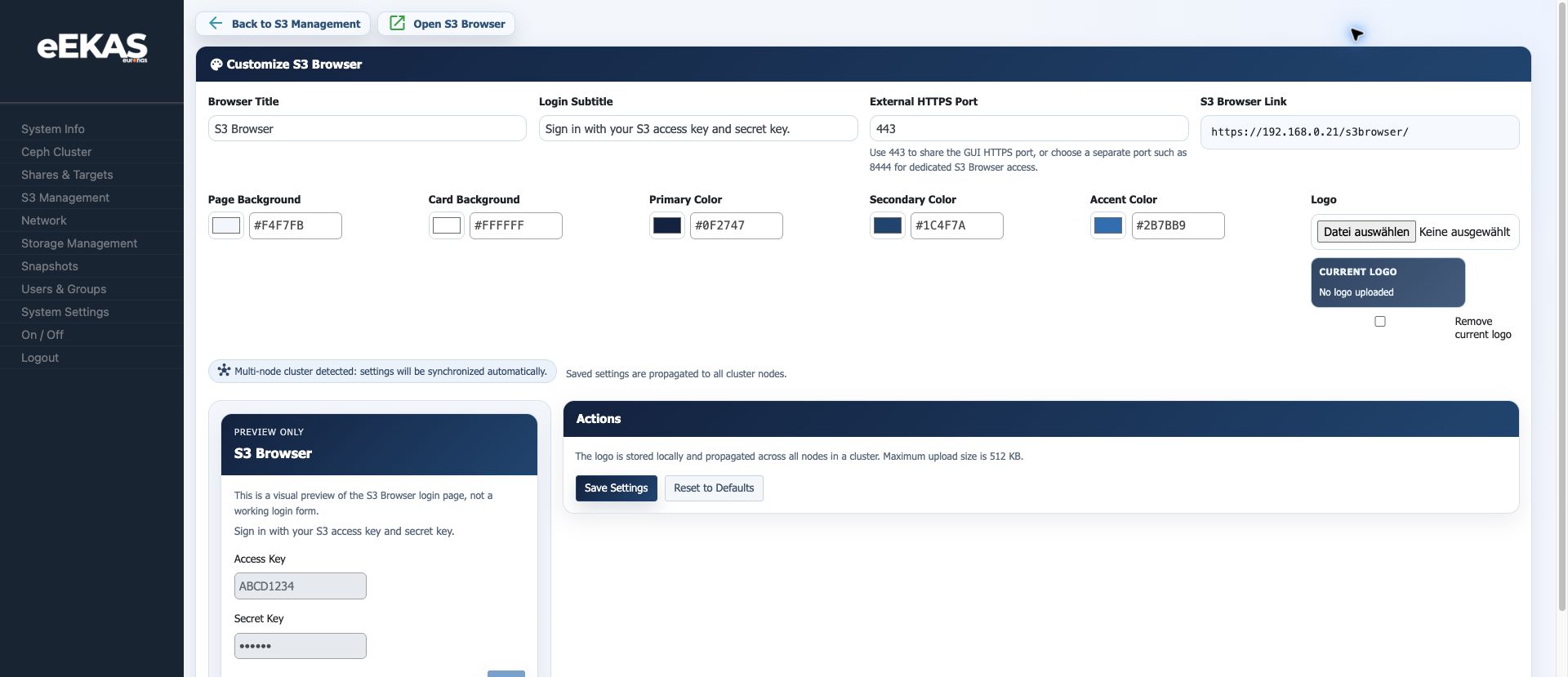
Available settings include:
| Setting | Description |
|---|---|
| Browser Title | Title shown in the S3 Browser UI. |
| Login Subtitle | Help text shown on the login page. |
| External HTTPS Port | Browser access port. Port 443 shares the GUI HTTPS port; another port such as 8444 can be used for dedicated browser access. |
| S3 Browser Link | Direct URL for end users. |
| Page Background | Login/page background color. |
| Card Background | Login card background color. |
| Primary Color | Main header/action color. |
| Secondary Color | Secondary UI color. |
| Accent Color | Highlight/accent color. |
| Logo | Optional customer or provider logo. |
The page notes that multi-node cluster settings are synchronized automatically and propagated across all nodes.
Recommended Branding Workflow
- Set browser title and login subtitle.
- Configure the external HTTPS port.
- Upload the customer or provider logo if required.
- Adjust colors and verify the preview.
- Save settings.
- Open the S3 Browser link and verify the real login page.
Security Notes
- The S3 Browser does not require Apache authentication for end-user access.
- End users authenticate with S3 access key and secret key.
- Users should only see buckets that are assigned to them.
- Use HTTPS and trusted certificates for production endpoints.
- Avoid sharing access keys and secret keys in screenshots or tickets.
- Mark screenshots that show filled access keys or secret keys as sensitive and do not publish them.
Source: eEKAS live test cluster and supplied euroNAS eEKAS documents, prepared on 2026-07-09.